Signs of a Roof Leak After Heavy Rain
How to spot a roof leak after a North Jersey downpour, where water actually enters versus where it shows up, and when to call for repair.
Why leaks show up hours or days after the rain stops
A lot of homeowners assume a leak has to appear during the storm itself, but that is often not the case. Water can travel along a rafter, a piece of sheathing, or a layer of old felt for several feet before it finds a gap in the drywall or insulation and drips into the living space. That is why a ceiling stain frequently shows up a day or two after a heavy summer downpour or a wind-driven nor'easter has already passed.
This delay also explains why the spot on your ceiling is rarely directly under the actual hole in the roof. Water follows the path of least resistance across the deck and framing, so the entry point could be several feet uphill from where you see the stain. That mismatch is the main reason DIY caulking at the visible spot so often fails to fix anything.
In North Jersey, the two conditions that push the most water past a marginal roof are sustained wind-driven rain from coastal storms and the sheer volume of a fast summer thunderstorm overwhelming a gutter or valley. Both conditions expose weak spots that a light, straight-down rain never would.
Ceiling and wall signs to check first
Start with the attic if you have access, since it is the most direct evidence you will find. Look for damp insulation, dark streaks on the underside of the roof deck, rust on nail tips, or a musty smell. A flashlight run along the rafters near chimneys, vent pipes, and skylights will often reveal a trail of old and new staining that tells you the leak has been active for a while.
Inside the house, a fresh yellow-brown ring on a ceiling, a soft or sagging spot in drywall, and paint that is bubbling or peeling near an exterior wall are all classic signs. Bathrooms and rooms under a flat rear addition tend to show problems first, since those roof sections handle more standing water.
Check window and door trim on upper floors too. Water that gets behind siding or under a step-flashing detail near a roof-to-wall intersection often tracks down inside the wall cavity and appears as staining well below the roofline, which throws people off when they are looking for the source.
Where the water is actually getting in
Flashing failures are the single most common entry point. This includes step flashing along dormers and chimneys, counter-flashing at masonry, and the metal around skylights and vent pipes. These are pieced-together metal details, and they rely on caulk and lap sequencing that degrades over ten to fifteen years even on a roof with plenty of shingle life left.
Valleys are the next most common culprit, especially on the older colonials and capes common in Garfield, Clifton, and Passaic. A valley channels a large volume of water from two roof planes into one narrow path, and any granule loss, nail exposure, or debris buildup there gets tested hard during a heavy rain.
On flat rear additions, common in Newark, Paterson, and Jersey City rowhouse and multi-family construction, ponding water and aged membrane seams are frequent leak sources. These roofs are nearly flat by design, so any low spot holds water long after a storm and slowly works its way through a seam or a penetration.
What to do the moment you find a leak
Move anything valuable out from under the drip and place a bucket or a container to catch the water. If a section of ceiling is bulging with trapped water, it is safer to puncture it in the center with a screwdriver to release the water in a controlled way than to let it collapse on its own.
Do not go up on the roof to look for the source yourself, especially during or right after a storm when shingles are wet and slippery. If the leak is active and heavy, a tarp placed over the suspected area by a professional can prevent further interior damage while you schedule a full inspection.
Photograph the interior damage as soon as you notice it: the ceiling stain, any bulging, and standing water on floors. These photos are useful both for your own repair records and if you end up filing an insurance claim.
What a professional inspection actually finds
A roofer inspecting a leak walks the roof looking for the specific failure, not just the general area. That means checking flashing laps, probing the deck near the stain for soft spots, and looking at the attic side for the trail of staining that points back to the true entry point.
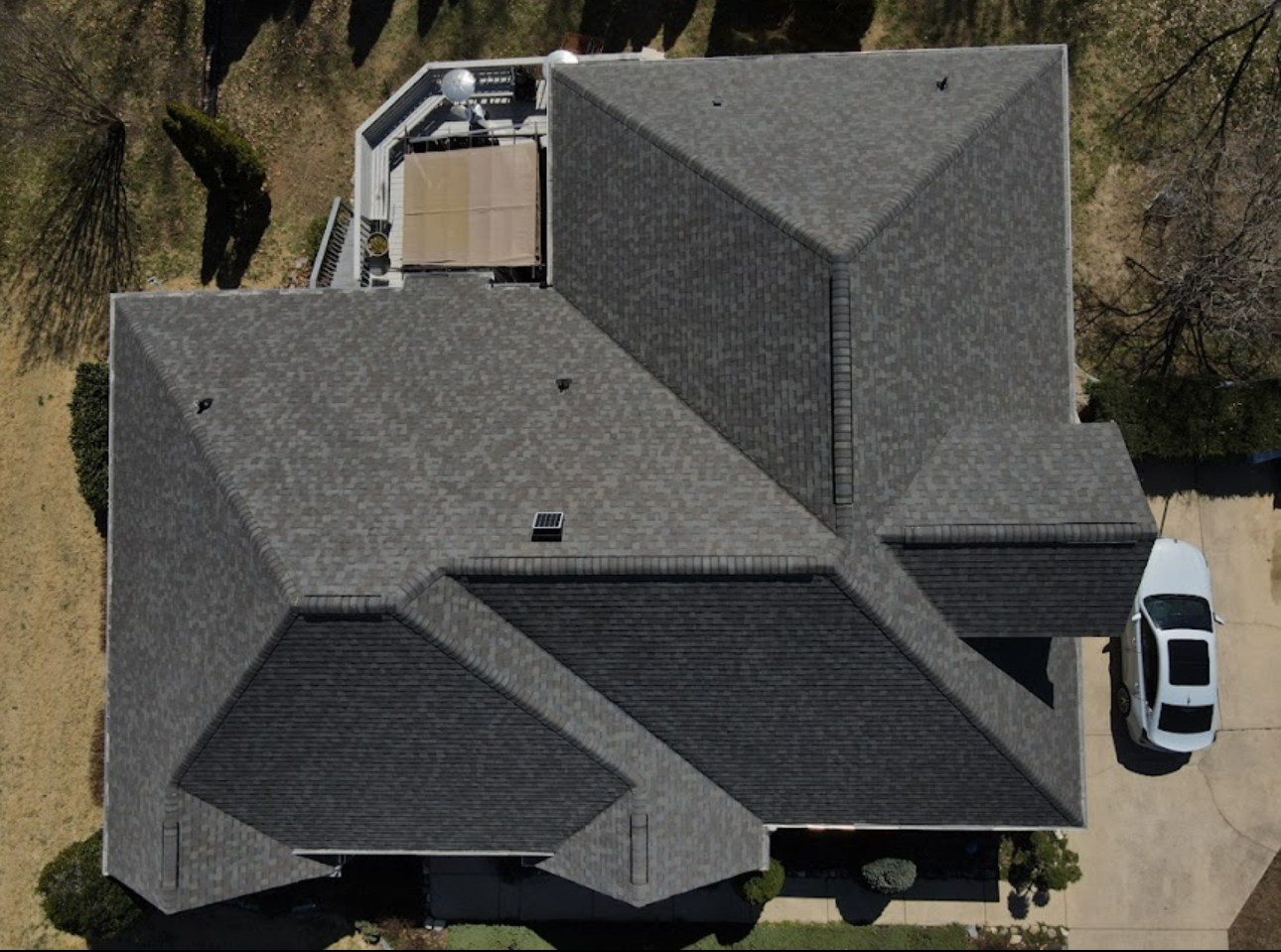
We use a free drone roof inspection to document conditions on the field of the roof without unnecessary foot traffic, then confirm any suspect areas up close. That combination usually finds the real source faster than a ground-level guess, and it gives you photos of the actual damage.
Most single-point leaks caused by flashing or a localized shingle failure fall into the common repair range of $450 to $2,500 as a planning estimate. Leaks tied to widespread deck rot or a roof near the end of its service life may point toward replacement instead, which we will tell you plainly rather than patch repeatedly.
Preventing repeat leaks after the first storm
Once a leak is repaired, keep an eye on the same spot after the next few heavy rains. A properly repaired flashing detail or valley should hold in wind-driven rain, not just a light shower, so that next storm is the real test.
Clean gutters and downspouts before the fall and spring rain seasons. A clogged gutter forces water to back up under the shingle edge or over the fascia, which can mimic a roof leak even when the shingles themselves are fine.
If your home has a flat or low-slope section, have it checked after any storm with sustained heavy rain, since ponding and seam issues develop quietly and are easy to miss from the ground.
Questions homeowners ask us on the phone
Why does my roof only leak during heavy rain and not light rain?
Light rain rarely tests flashing laps, valleys, or marginal shingle seals the way sustained, wind-driven rain does. Heavy storms push more water volume and force it sideways under edges that a gentle rain never reaches, which is why leaks often only appear during or after a significant storm.
Is it normal for a leak to show up a day after the storm ends?
Yes. Water often travels along the roof deck or framing before it finds a gap and drips through the ceiling, so a delay of a day or two between the rain and the visible stain is common. The eventual stain location is not always directly under the true entry point.
Can I just caulk the spot where I see the ceiling stain?
Usually not effectively. The stain location is often several feet from the actual entry point on the roof, since water travels along framing before dripping down. Caulking the visible spot from inside does not address the source and can mask the problem while damage continues.
How much does it cost to fix a roof leak in New Jersey?
Most single-point leaks tied to flashing, a valley, or localized shingle damage fall between $450 and $2,500 as a planning estimate, depending on access and the extent of the repair. Leaks connected to widespread deck rot or an aging roof may cost more or point toward replacement.
Should I go up on my roof to check for leak damage myself?
We do not recommend it, especially right after a storm when shingles are wet and slippery. A ground-level and attic-level check for obvious signs is fine, but locating and confirming the actual entry point is safer and more accurate when done by a professional with proper equipment.
Run your roof size, material and pitch through our New Jersey roof cost calculator for a planning range in about 30 seconds, then call +1 (201) 994-8577 for a free on-site inspection and written estimate.
Call +1 (201) 994-8577