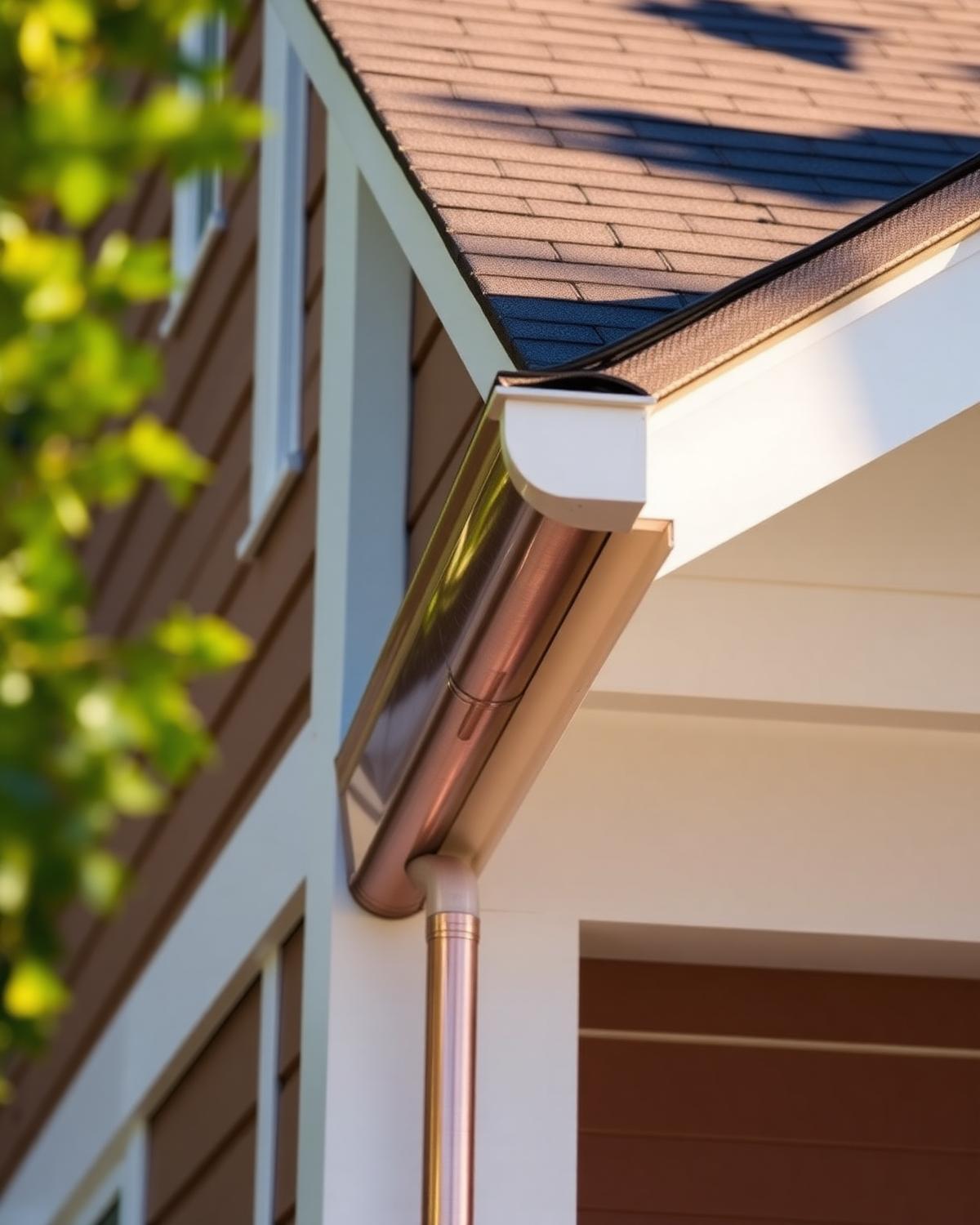
Service 04 · Gutters

Move water away from your foundation.

Clogged or undersized gutters cause more foundation damage than any other exterior failure. We install seamless aluminum, copper, and zinc gutter systems sized correctly for your roof's drainage area, with downspout extensions or French drains where needed.

Free Inspection · 24-hr response

Get your project quote.

We respond within 2 business hours. No spam, ever.

What's included

Our gutters services

  • Seamless 5" and 6" aluminum gutters
  • Copper & half-round specialty systems
  • Leaf-guard & micro-mesh covers
  • Downspout & drainage extensions
  • Fascia & soffit repair
  • Free annual cleaning with new install
Gutters work in New Jersey
The honest version

What gutters work in North Jersey actually involves

Gutters are the least glamorous part of the exterior and the one with the widest gap between cost and consequence. The system itself is inexpensive relative to a roof or a foundation, but when it fails the water goes somewhere — into the fascia, down the siding, or against the foundation. A significant share of the basement seepage we get called about is not a waterproofing problem at all. It is roof water being delivered directly to the foundation wall.

The most common technical mistake we find in our area is undersizing. Standard 5-inch K-style gutter with 2x3 downspouts is adequate for a modest roof at a moderate pitch. On a steep roof, water builds velocity down the slope and overshoots the front lip entirely in heavy rain, no matter how clean the gutter is. On those homes, moving to 6-inch gutter with 3x4 downspouts fixes the problem without touching the roof.

Seams are the other variable. Sectional gutter from a big-box store has a joint every ten feet and every joint is a future leak. We run seamless aluminum formed on site to the exact length of each run, so the only joints in the system are at corners and outlets where they are properly sealed.

How the job runs

Start to finish, step by step.

No surprises mid-job. This is the same sequence on every project we take.

01

Assess roof area, pitch and drainage

We calculate what the roof actually sheds and where it needs to go. That determines gutter size, downspout count and placement — not a default that gets applied to every house.

02

Check fascia condition

Failed gutters usually mean water has been running behind them. We inspect the fascia and check for rot before hanging anything new, because new gutter on compromised fascia will not hold.

03

Form seamless runs on site

Aluminum is roll-formed on our truck to the exact length of each run, so there are no mid-run seams to fail. You choose the color at estimate.

04

Hang with hidden hangers and correct pitch

Hidden hangers screwed into solid framing hold far better than the old spike-and-ferrule method. Each run is pitched to drain properly to its outlet rather than hung dead level.

05

Downspouts and discharge

We size and place downspouts for the actual roof load and, critically, route the discharge well away from the foundation — surface extension or a dry well, not straight down at the wall.

06

Guards where they earn their keep

On heavily wooded lots, quality leaf guards pay for themselves quickly. On an open lot they often do not. We will tell you which one you have rather than selling guards by default.

What drives the price

Why two quotes can look nothing alike.

Total linear footage
The straightforward driver: how many feet of gutter the house needs. Measured at the estimate rather than approximated.
Gutter and downspout size
Upsizing from 5-inch to 6-inch with larger downspouts costs somewhat more in material and is the correct call on steep or large roofs. It is cheaper than repeatedly addressing overflow damage.
Number of stories and access
Third-story runs and difficult access require more staging time, which shows up in labor.
Fascia repair
If water has already damaged the fascia board, it has to be repaired before new gutter goes up. We identify this at inspection.
Guards and drainage work
Leaf-guard systems and any underground drainage or dry-well work are priced separately so you can decide on each independently.
Signs it's time to call
  • Water sheeting over the front edge of the gutter during heavy rain
  • Gutters visibly sagging or pulling away from the fascia
  • Vertical staining or streaking on siding below the gutter line
  • Soil erosion, mulch washout or pooling directly beneath downspouts
  • Basement dampness that appears specifically after heavy rainfall
  • Peeling paint or soft wood on the fascia board behind the gutter

Seeing any of these? A free inspection costs you nothing and you get the photos either way.

Common questions

What homeowners ask us.

How often should gutters be cleaned?+

Twice a year in NJ — once in late spring, once after leaf-fall. With leaf-guard installed, you can stretch that to every 2–3 years.

What size gutter do I need?+

Most NJ homes need 5" K-style. Larger roofs or steep pitches benefit from 6" gutters with 3x4" downspouts to handle heavy storms.

Don't just take our word for it

See what your neighbors say.

Loading…
Ready when you are

Need gutters work done right?

Call nowGet $500 Off